Science · Air changes per hour
ACH counts the room.True ACH counts the people.
Air changes per hour divide the supply airflow by the volume of the room. The figure tells how much air goes in, not where it goes. True ACH is the same figure taken where it matters: in the breathing zone.
True ACH
=
ACH
×
Share delivered to the breathing zone
On the drawings
6ACH
In the breathing zone
True ACH
Conceptual illustration only. It shows the principle, not a measurement: real temperatures, airflows and air quality vary from one room, system and building to the next.
What ACH measures
One division, and the room disappears.
ACH is the volume of air supplied in one hour divided by the volume of the room. Its simplicity made it the common language of ventilation. It also treats the room as a tank that mixes perfectly, at every height.
The formula
Example: 2,000 ft² × 10 ft, supplied with 2,000 cfm: 60 × 2,000 ÷ 20,000 = 6 ACH.Example: 185 m² × 3 m, supplied with 925 L/s: 3.6 × 925 ÷ 555 = 6 ACH.
In the division
- ✓The supply airflow
- ✓The room volume
Not in the division
- ×Where the air goes
- ×Where the people are
- ×How well the room mixes
Total supply airflow of the room. Some standards also require a number of outdoor air changes, calculated the same way with the outdoor airflow.
Raise the ceiling. Nothing else changes.
Same floor, same people, same airflow. Only the ceiling moves.
Air changes per hour
Airflow per person
unchanged
Airflow per unit of floor
unchanged
01
It counts air nobody breathes
The volume above the occupants weighs as much in the division as the six feet where they live. A tall room needs more airflow for the same ACH, whether or not that air comes down.
02
It cannot see the path
Supply air that runs along the ceiling to the return, or stays in a warm layer under the roof, counts in full. The ACH is identical whether the air crosses the breathing zone or never reaches it.
03
The return cannot see it either
Whatever the mixing, the air at the return has exactly the nominal age: room volume ÷ airflow. That is a property of every ventilated room. A reading at the return grille will therefore confirm the design ACH even when the occupants get a fraction of it.
True ACH
The air change rate of the breathing zone.
True ACH is the rate at which the air around the occupants is actually replaced by supply air. It is expressed on the same scale as ACH, so the two can be compared, and so can the values the standards publish.
Delivered share. How fast the air of the breathing zone is renewed, relative to a room that mixes perfectly. It is the nominal time constant (volume ÷ airflow) divided by the mean age of air in the breathing zone: the air-change effectiveness that ASHRAE Standard 129 measures, called the local air change index in the ventilation literature.
Estimate
For a first indication, the zone air distribution effectiveness Ez of ASHRAE 62.1, Table 6-4: 0.8 for warm air supplied and returned at the ceiling, 1.0 for cool air supplied at the ceiling. A related factor, not the same measurement.
The Ez factorSimulate
A CFD study gives the mean age of air at every point of the room, before it is built.
The Verified serviceMeasure
A tracer-gas test gives the age of air at breathing height in the finished room (ASHRAE 129).
Perfect mixing: True ACH = ACH
The published ACH values assume it. Read as True ACH, they keep their meaning in a room that does not mix perfectly.
The breathing zone, as ASHRAE 62.1 defines it
Between 3 and 72 in (75 and 1800 mm) above the floor and more than 2 ft (600 mm) from the walls or fixed air-conditioning equipment.
A design rule
Size the system so that True ACH, not the nominal ACH, meets the required value. A room that needs 6 and delivers 70 % of its air to the breathing zone needs 8.6 nominal, or a better air distribution.
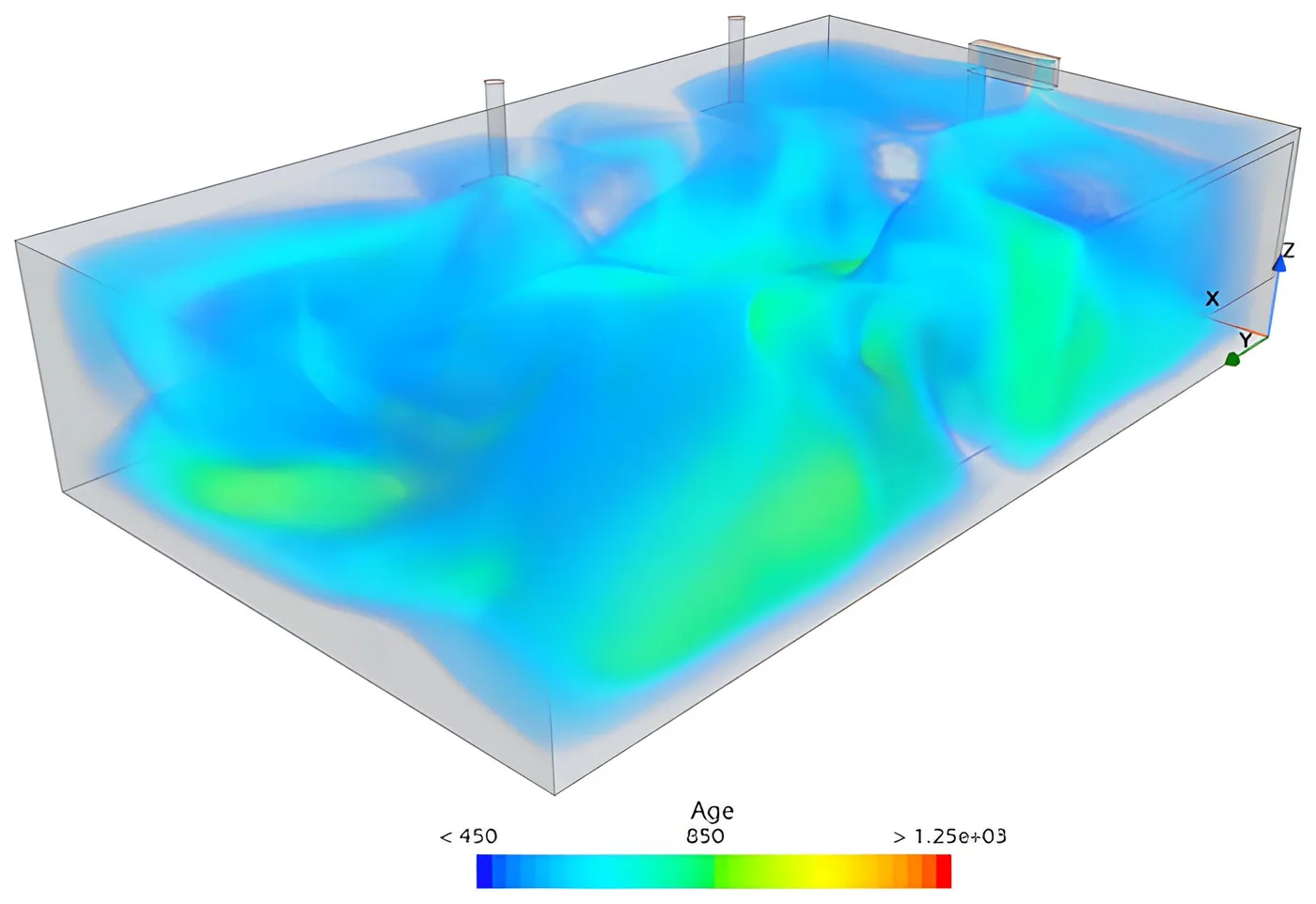
Mean age of air · Verified simulation
From the age of air to the True ACH
What a study returns: the mean age of air at every point of the room, here in seconds. The local air change rate is 3,600 ÷ age: 450 s is 8 air changes per hour at that point, 1,250 s is fewer than 3. True ACH is 3,600 ÷ the mean age of air in the breathing zone.
See it in a room
Same ACH. A different room every time.
A section through a room with ceiling diffusers and a ceiling return. Set the nominal ACH, raise the ceiling and choose how far down the supply air goes. The colours show the local air change rate; the breathing zone carries the True ACH.
Local air change rate, relative to the nominal ACH
Conceptual illustration only. It shows the principle, not a measurement: real temperatures, airflows and air quality vary from one room, system and building to the next. The flow is simplified and two-dimensional; the age of air is then calculated on it the way a CFD code does. It is not a study of your room: a real True ACH comes from a simulation or a measurement.
Nominal ACH
True ACH
Delivered to the breathing zone
Nominal ACH needed for a True ACH of
Calculator
Your room, in ACH and in True ACH.
Enter the room and its supply airflow. Choose the delivered share from the ASHRAE 62.1 defaults or enter the one from a study.
Defaults · ASHRAE 62.1, Table 6-4
Nominal ACH
True ACH
Airflow for the requirement, at this delivered share
The same requirement with perfect mixing
ACH = hourly supply airflow ÷ (area × height). True ACH = ACH × delivered share. The Table 6-4 values are defaults for ventilation air, defined on contaminant concentration: they are used here as a first indication only. A CFD study or a tracer-gas test gives the value of the room.
Reference values
The published air change rates, in one place.
Selected values from the standards and guidelines that prescribe or cite air changes. Each is written for a room that mixes perfectly. Set the delivered share to read what the nominal figure must be for the True ACH to meet it.
| Space | Total ACH required | of which outdoor air | Nominal ACH to supply |
|---|---|---|---|
| Patient room | 4 | 2 | |
| Critical and intensive care | 6 | 2 | |
| Newborn intensive care | 6 | 2 | |
| Operating room | 20 | 4 | |
| Procedure room | 15 | 3 | |
| Bronchoscopy | 12 | 2 | |
| Airborne infection isolation (AII) room | 12 | 2 | |
| Protective environment (PE) room | 12 | 2 | |
| Emergency department exam or treatment room | 6 | 2 | |
| Emergency department public waiting area | 12 | 2 | |
| General examination room | 4 | 2 | |
| Laboratory work area, general | 6 | 2 | |
| Pharmacy | 4 | 2 | |
| Toilet room (exhausted) | 10 | – |
Minimum air changes for inpatient spaces; the patient room was 6 in the 2008 edition. A 2025 edition has been published. Standard 170 already reasons on the occupied volume in one case: for single-bed patient rooms with Group D diffusers, the 2017 edition as amended asks for six air changes calculated on the volume from the floor to 6 ft (1.83 m). Selected rows, for orientation. The standard governs: check the current edition, its addenda and the code adopted in your jurisdiction. Source: ANSI/ASHRAE/ASHE Standard 170-2021 with addenda, Table 7-1.
ASHRAE 62.1 does not prescribe an ACH: it sets an outdoor airflow per person and per unit of floor area. Converted to air changes, that airflow depends on the ceiling height.
| Space type | Outdoor air per unit of floor | Outdoor air ACH | To supply at this delivered share |
|---|---|---|---|
| Office space | |||
| Classroom (age 9 and over) | |||
| Conference or meeting room | |||
| Retail sales | |||
| Gym or sports arena, play area | |||
| Health club, weight room |
Selected rows, for orientation. The standard governs: check the current edition, its addenda and the code adopted in your jurisdiction. Source: ANSI/ASHRAE Standard 62.1-2022, Table 6-1 (default occupant densities).
Time needed to remove an airborne contaminant once its source has stopped. The CDC table assumes perfect mixing; the last columns redo the calculation with the True ACH. Times in minutes.
| ACH | 99 % · CDC | 99.9 % · CDC | 99 % at the True ACH | 99.9 % at the True ACH |
|---|---|---|---|---|
| 2 | 138 | 207 | ||
| 4 | 69 | 104 | ||
| 6 | 46 | 69 | ||
| 8 | 35 | 52 | ||
| 10 | 28 | 41 | ||
| 12 | 23 | 35 | ||
| 15 | 18 | 28 | ||
| 20 | 14 | 21 | ||
| 50 | 6 | 8 |
For an empty room with no source still emitting. The CDC states that its times assume perfect mixing (mixing factor = 1), that perfect mixing usually does not occur, and that removal takes longer where mixing is imperfect or the air stagnates. Source: CDC, Guidelines for Environmental Infection Control in Health-Care Facilities, Appendix B, Table B.1.
Commonly cited values for laboratories, cleanrooms and occupied buildings, for orientation. They are not requirements: the airflow of a laboratory or a cleanroom is set by an analysis of the hazard and the process.
| Application | Air changes per hour | Source |
|---|---|---|
| Laboratory, occupied: fixed minimums used in the past (the Handbook now advises setting the rate room by room) | 4–12 | ASHRAE Handbook, HVAC Applications (2019), ch. 17 |
| Laboratory with active air-quality sensing, while the air is clean | 2 | ASHRAE Handbook, HVAC Applications (2019), ch. 17 |
| Biosafety level 2 laboratory, typical criteria | 6–15 | ASHRAE Handbook, HVAC Applications (2019), ch. 17 |
| Animal rooms | 10–15 | National Research Council (2011), cited in the ASHRAE Handbook, ch. 17 |
| Cleanroom, ISO Class 8: usually sufficient according to the FDA | 20 | ASHRAE Handbook, HVAC Applications (2019), ch. 19 |
| Cleanroom, ISO Class 5: IEST rule of thumb (operating cleanrooms were mostly measured below it) | 240–480 | IEST-RP-CC012.1, cited in LBNL-51549 (Xu, 2002) |
| Occupied buildings, to reduce respiratory virus spread: clean air from outdoor air, filtration and air cleaning together | ≥ 5 | CDC / NIOSH, “Aim for 5” |
Selected rows, for orientation. The standard governs: check the current edition, its addenda and the code adopted in your jurisdiction.
ASHRAE Standard 241 does not prescribe an ACH either: it sets an equivalent clean airflow per person, which outdoor air, filtration or air cleaning can provide.
| Occupancy category | Equivalent clean airflow per person |
|---|---|
| Office | 30 cfm15 L/s |
| Classroom | 40 cfm20 L/s |
| Lecture hall | 50 cfm25 L/s |
| Retail | 40 cfm20 L/s |
| Food and beverage facilities | 60 cfm30 L/s |
| Gym | 80 cfm40 L/s |
| Health care: exam room | 40 cfm20 L/s |
| Health care: patient room | 70 cfm35 L/s |
| Health care: waiting room | 90 cfm45 L/s |
Minimum equivalent clean airflow per person in the breathing zone, in infection risk management mode. The standard defines it as pathogen-free air distributed uniformly within the breathing zone: the delivery to the occupants is part of the requirement. Selected rows, for orientation. The standard governs: check the current edition, its addenda and the code adopted in your jurisdiction. Source: ASHRAE Standard 241-2023, Table 5-1.
Raise the True ACH
More of the air you already move, where the people are.
01
High induction
Fast jets pull room air into the supply and mix it before it can reach the return.
High-induction diffusers02
Heating from high ceilings
ACTIF diffusers change their pattern with the supply temperature and drive warm air down instead of leaving it under the roof.
Thermal diffusers03
Long throws for tall spaces
Nozzle diffusers carry the air across a hall, or from high on a wall down to the occupied zone.
Nozzle jet diffusers04
Supply and return placement
A return placed out of the supply’s direct path makes the air cross the breathing zone before it leaves the room.
The Ez factor05
See it before it is built
SelectiV shows each diffuser’s jets in your room, in cooling and in heating.
SelectiV06
Have it calculated
Verified simulates the whole room: mean age of air, Ez and the True ACH of the breathing zone.
VerifiedCommon questions
ACH, in short.
How do you calculate air changes per hour?
Multiply the supply airflow in cfm by 60 and divide by the room volume in cubic feet (in metric: L/s × 3.6 ÷ m³). A 2,000 ft² room with a 10 ft ceiling supplied with 2,000 cfm has 6 air changes per hour.
What is True ACH?
The air change rate in the breathing zone: the nominal ACH multiplied by the share of that air renewal that reaches the occupants. With perfect mixing it equals the ACH; with stratification or short-circuiting it is lower.
Is a higher ACH always better?
Not by itself. Moving more air through a room that stratifies or short-circuits mostly raises fan and conditioning energy. Delivering the same air to the breathing zone raises the True ACH without more airflow.
Does True ACH replace the ACH required by a code?
No. Where a code or a standard prescribes air changes, that value must be met as written. True ACH is a design check on top of it: it tells whether the occupants actually receive the air change rate the requirement intends.
Read next
Where the air goes, everything else follows.
SelectiV · Verified
Designing a room? Start with the air.
Use SelectiV to lay out diffusers in 3D, or ask for a Verified CFD study to validate comfort, IAQ and energy before anything is installed.