

High-induction diffusers
Small openings.Pressurized plenum.Even air.
Every EffectiV high-induction diffuser combines a face with many small openings and a plenum box that pressurizes the air before it leaves. The openings raise the discharge velocity, so the jets draw in room air and mix fast. The plenum feeds every opening the same, whatever the ductwork does above the ceiling.
- 01
- High discharge velocity
- Small openings, less free area
- 02
- More room air induced
- The jet drags room air in
- 03
- Even airflow
- The same airflow on every side
Seen from belowSupply airRoom air induced
01 · How induction works
Velocity pulls the room in.
A jet of air leaving the diffuser at high velocity does not travel alone. Along its edges it drags the still room air around it into itself and carries it along. The higher the discharge velocity, the more room air it pulls in: the jet grows, slows and warms up at the ceiling, long before it reaches people.
Discharge velocity
The jet stays concentrated.
At low discharge velocity the jet pulls in little room air. It keeps its cold, runs along the ceiling, separates and drops into the occupied zone: a draft.
The jet mixes at the ceiling.
At high discharge velocity the jet pulls in a lot of room air. The supply is mixed and slowed at the ceiling, before it reaches people.
Room air pulled in
Cold drafts reaching people
Comfortable-temperature jet reaching people
01
The jet leaves fast
Air leaves the face at high velocity, in a thin jet along the ceiling.
02
It drags the room in
Shear along its edges entrains the still air around it: room air pours into the jet, the more so the faster it goes.
03
It mixes at the ceiling
The jet grows, slows down and warms up. What comes down to people is air that is already mixed.
Illustration of the principle, not a CFD run of a specific product. Throws and data for each diffuser are in SelectiV.
02 · The installation problem
Every inch goes to the room.
Architects want the ceiling as high as possible, and engineers design with the space left above it. The flexible duct then has to bend hard into the top of the diffuser. In a diffuser with large openings and an integral collar, the kink throws the air to the far side: most of it leaves through one side, the rest is split between the other three. A high-induction face on a pressurized plenum, fed from the side, gives the diffuser even airflow back, whatever the installation.
Mixing
The problemUneven: one side of the room overcooled, the other barely reached.
With a plenumEven: the same pattern on every side.
Drafts
The problemThe strong side runs well above its design velocity and reaches people.
With a plenumEvery side at its design velocity.
Pressure
The problemThe kink and the overloaded side add pressure the fan has to deliver.
With a plenumThe duct goes straight into the side of the plenum: no kink, and no side of the face is overloaded.
Noise
The problemHigher local velocity, higher NC.
With a plenumVelocity spread evenly: the NC the catalogue states.
03 · The family
Four families, one principle.
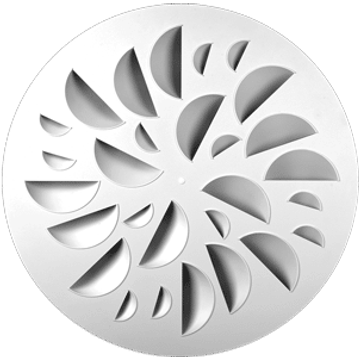
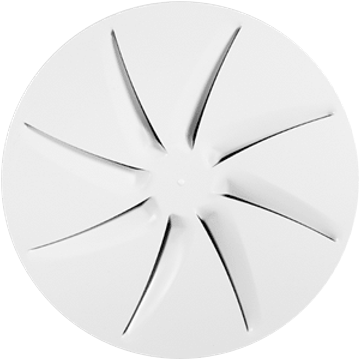
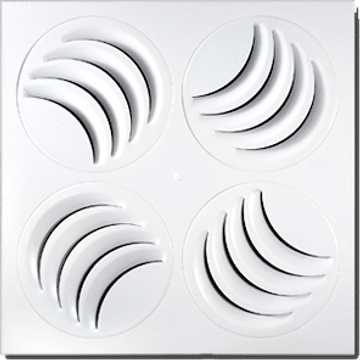
NEX, OTO, PLAY and AXO look nothing alike. Behind each face: many small openings and a plenum that pressurizes the air.

NEX
Concave elements, round or square
A high-induction swirl in an architectural face, for open ceilings, drywall and lay-in.
See the family
OTO
Eight curved slots
A rotational jet from a seamless face stamped from a single sheet, designed with Lievore Altherr Molina.
See the family
PLAY
Sectors that turn 360°
Each round sector rotates from the face: swirl, four-way, two-way or one-way, adjusted on site.
See the family
AXO
Adjustable vanes
High-induction swirl with a high tolerance to airflow variation and to the angle of the duct entering the diffuser; AXO-TWIN for VAV.
See the familyWhere it matters
Induction, underneath everything else.
SelectiV · Verified
Designing a room? Start with the air.
Use SelectiV to lay out diffusers in 3D, or ask for a Verified CFD study to validate comfort, IAQ and energy before anything is installed.