Advanced continuing education · 2.0 h · free
Advanced air distribution, applied to real rooms.
Not another basics class. Twelve modules on what the air actually does in occupied rooms, with live simulations to play with and a short quiz after each. At the end, a certificate for 2.0 hours of continuing education, emailed to you and downloadable at any time.
- Advanced level
- Applied, room by room
- Live simulations
- 12 modules
- Free

Certificate of completion
Continuing education
2.0PDH
professional development hours
Completed
Certificate ID
EV-2026-······
This certifies that
Your name
has completed the online course
Air distribution for the occupied zone: induction, comfort, air quality and energy
Course content
- 01High induction: how discharge velocity mixes the room
- 02Thermal comfort: designing drafts out of the room
- 03Air distribution effectiveness: how Ez sets the outdoor air
- 04Indoor air quality: where the fresh air goes
- 05Energy efficiency: the diffuser as the last link
- 06Thermal diffusers: one diffuser for heating and cooling
- 07Nozzle jets: throw, coverage and large spaces
- 08Architectural duct diffusers: when the duct becomes the diffuser
- 09Architecture meets engineering: form, finish and airflow performance
- 10Room-level airflow prediction, between the catalogue and CFD
- 11CFD studies of the room: what they measure
- 12Room First: design from the occupants up
Your progress
Your certificate
Beyond the basics
Most courses stop at the catalogue. This one starts in the room.
The usual course
- Definitions: throw, drop, spread, NC
- Catalogue tables, one diffuser at a time
- Isothermal test-room conditions
- Selection by airflow and noise
This course
- How induction, discharge velocity and buoyancy shape the whole room
- Heating stratification, VAV at minimum airflow, kinked ducts: the failures you see on real jobs
- Ez, age of air and comfort, where people are
- Predicting the room before it is built: room-level prediction and CFD
How it works
- 01
Sign in by email
No password: we email you a sign-in link. Your progress is saved, so you pick up where you left off.
- 02
Read and try
Each module is a page of this site. A small panel at the bottom of the screen counts your reading time and the animations to try.
- 03
Answer the quiz
5 questions drawn at random, 4 right to pass. After a wrong answer, the explanation and the section to read again.
- 04
Get your certificate
After the twelve modules, your PDF certificate is emailed to you, with an ID and a QR code to verify it.
The twelve modules
12 modules · 103 min
- 01 10 min
High induction: how discharge velocity mixes the room
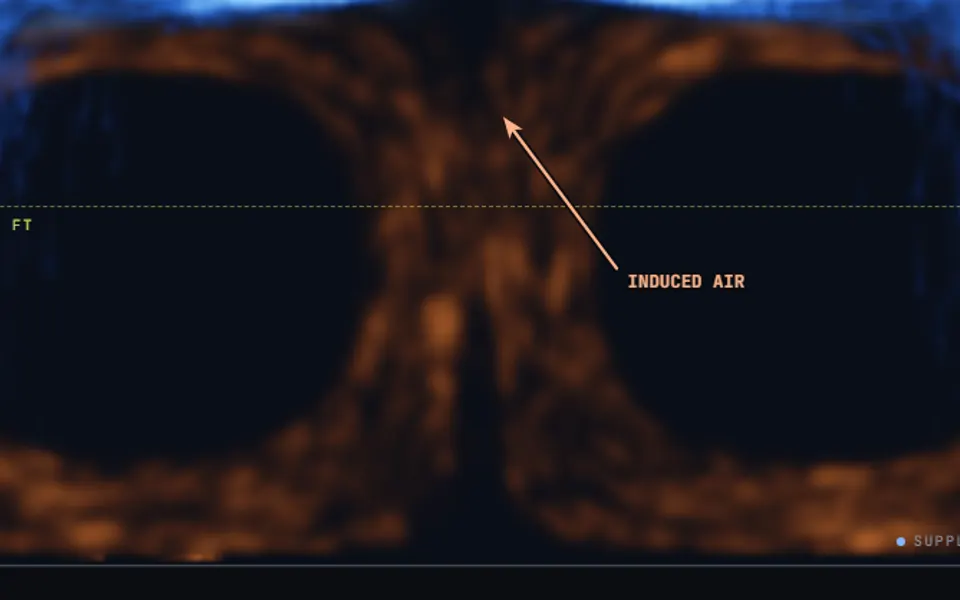
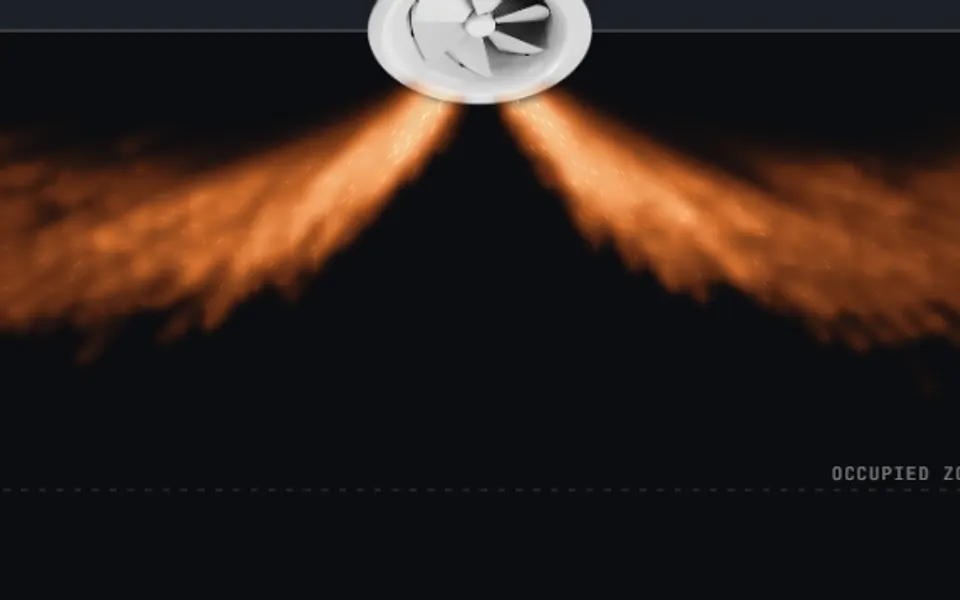
- Explain how a supply jet induces room air, and why discharge velocity controls how much.
- Describe what a low-velocity and a high-velocity cooling jet each do before they reach the occupied zone.
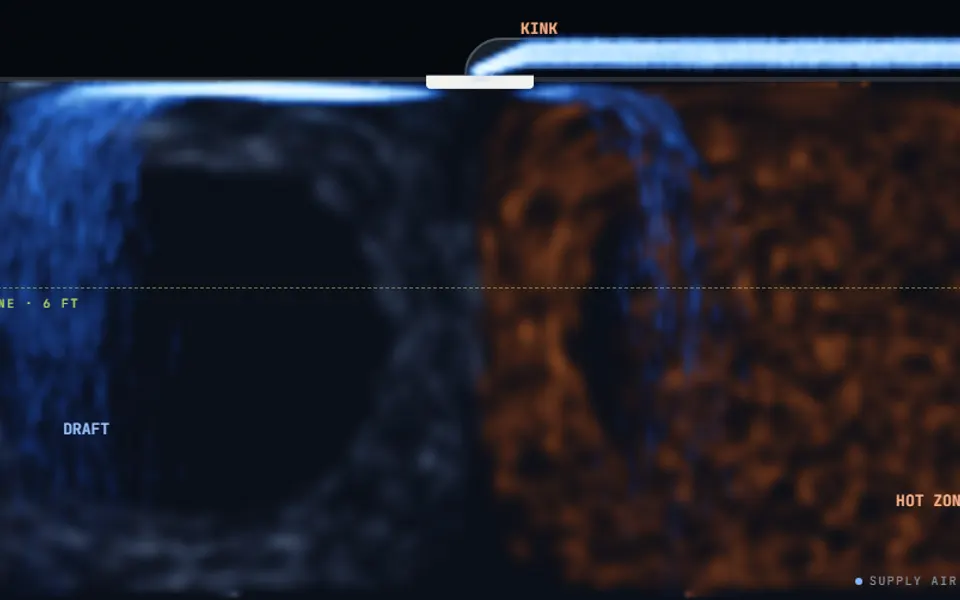
- Explain why a kinked flexible duct unbalances a diffuser with large openings and an integral collar, and how a pressurized plenum fed from the side restores even airflow.
- 02 10 min
Thermal comfort: designing drafts out of the room
- Identify which of the six thermal comfort factors air distribution controls, and why the draft from a ceiling diffuser is a measurable problem, not a matter of taste.
- Compare what low-induction and high-induction diffusers deliver to the occupied zone at high airflow and when a VAV system turns the airflow down.
- Apply the ADPI test: compute the effective draft temperature of a point in the occupied zone and judge whether it passes.
- 03 6 min
Air distribution effectiveness: how Ez sets the outdoor air
- Define zone air distribution effectiveness (Ez) and use Voz = Vbz / Ez to show how poorer mixing raises the outdoor air a zone needs.
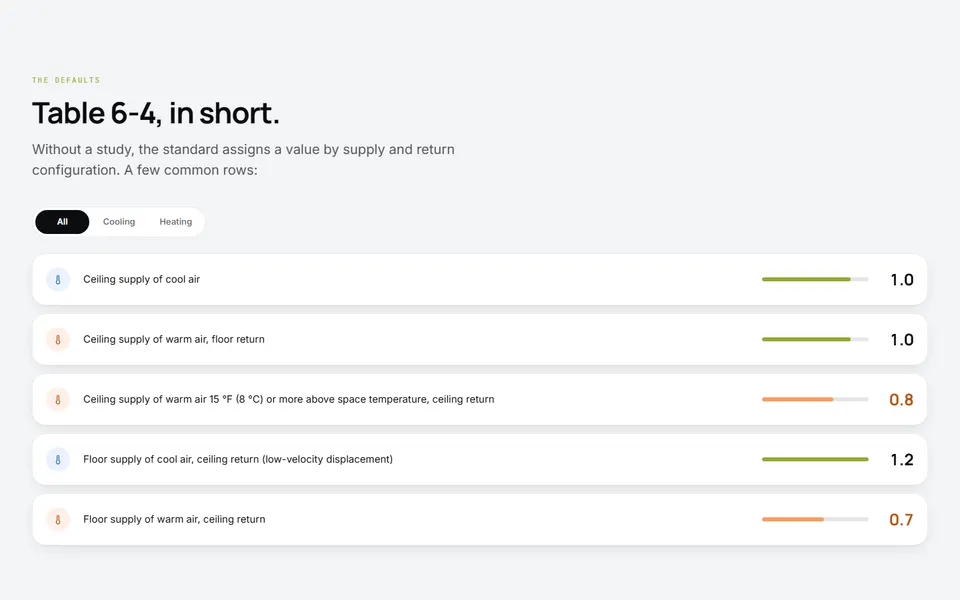
- Read the ASHRAE 62.1 Table 6-4 defaults and explain why some supply and return configurations get a lower value.
- Explain how Ez can be calculated for a specific project (Appendix C, CFD) and which air distribution design choices raise it.
- 04 7 min
Indoor air quality: where the fresh air goes
- Explain why indoor air quality depends on where the fresh air goes, not only on how much is supplied.
- Read an age-of-air section to compare a standard and a high-induction diffuser at the same airflow.
- Describe the three treatments inside a UV diffuser and pick a level of protection for a room.
- 05 12 min
Energy efficiency: the diffuser as the last link
- Explain why a diffuser, which uses no energy, decides whether the energy produced reaches the occupied zone.
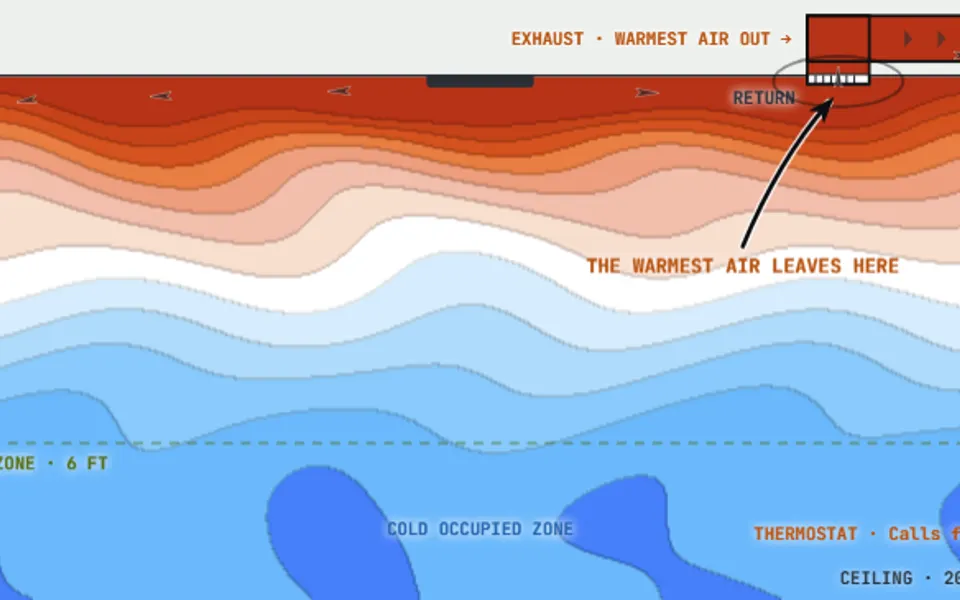
- Recognise five ways air distribution wastes energy (heating stratification, a misled thermostat, dumping at VAV minimum airflow, the VAV loop, a kinked duct) and the diffuser fix for each.
- Apply Voz = Vbz / Ez and explain why Ez = 0.8 is the ASHRAE 62.1 table default, not a fixed property of the room.
- 06 7 min
Thermal diffusers: one diffuser for heating and cooling
- Explain how an ACTIF diffuser sets its own diffusion angle from the supply air temperature, with no power or controls.
- Explain why cool air is thrown horizontally and warm air downward, and how that counters stratification under high ceilings.
- Distinguish an ACTIF thermodynamic diffuser from a VAV thermal diffuser and match the ACTIF models to their applications.
- 07 7 min
Nozzle jets: throw, coverage and large spaces
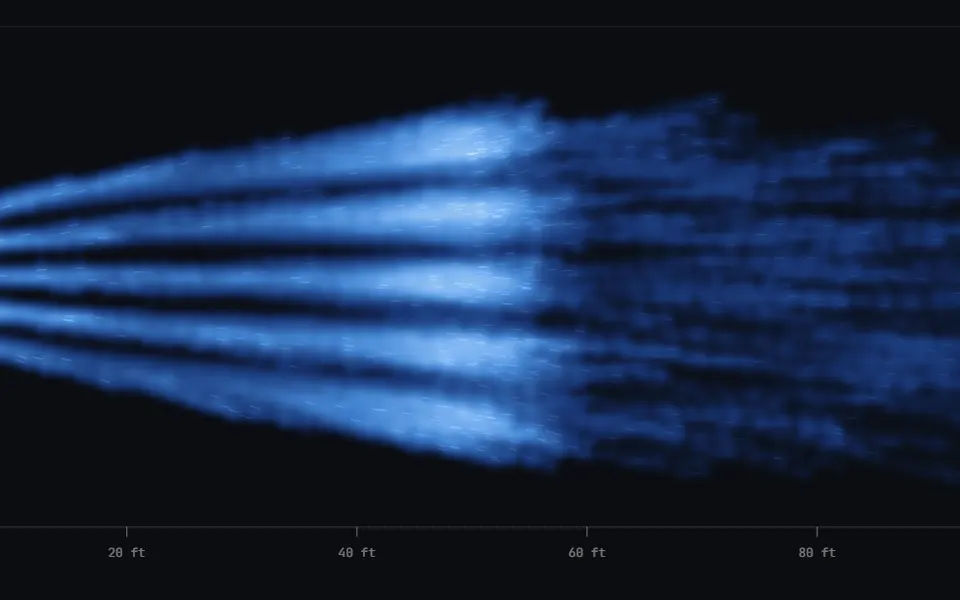
- Explain why a nozzle jet keeps its velocity over long distances where a ceiling diffuser cannot reach
- Trade throw against coverage by aiming the nozzles straight or angled
- Match the nozzle families and their adjustment modes (manual, actuator, ACTIF) to large-space applications such as open ceilings, pools and curtain walls
- 08 7 min
Architectural duct diffusers: when the duct becomes the diffuser
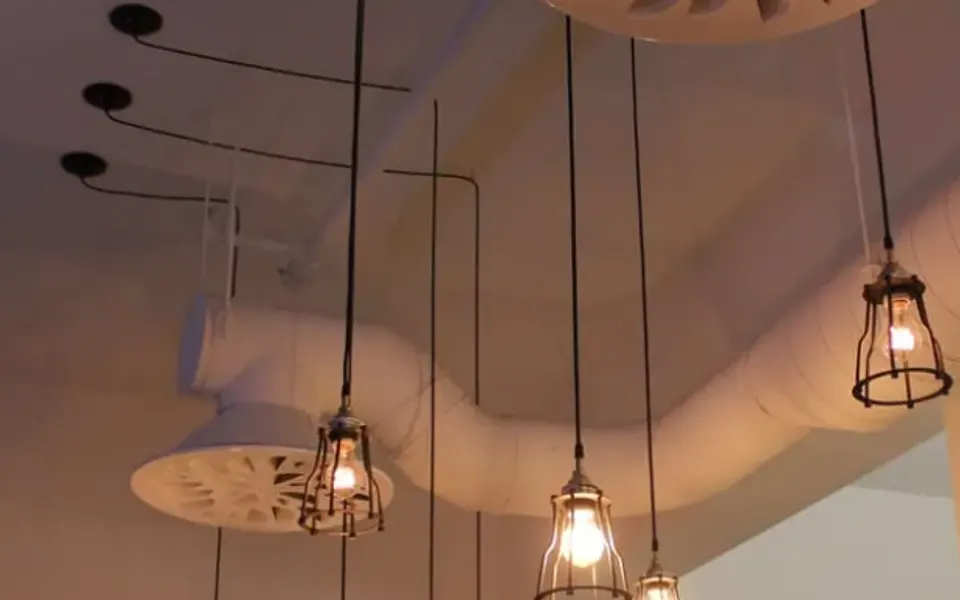
- Describe how an architectural duct diffuser merges ductwork and air terminal into one element
- Explain why a perforation pattern is designed from the room (geometry, occupancy, heating and cooling, targets) rather than picked from the duct
- Describe how the same perforated duct must behave in cooling and in heating, and how SelectiV and Auto-Design predict it before manufacturing
- 09 12 min
Architecture meets engineering: form, finish and airflow performance
- Explain why the diffuser, the one visible part of the HVAC system, must satisfy both the architect’s brief and the engineer’s brief
- Read a diffuser’s airflow performance (airflow, throw to 100 · 60 · 40 fpm, NC, pressure loss, induction) and predict how it moves with neck velocity and discharge pattern
- Distinguish catalogue performance, which is for representation, from room-level performance, which SelectiV predicts
- 10 10 min
SelectiV: room-level airflow prediction between the catalogue and CFD
- Explain why catalogue data evaluated outside the room is not enough, and name the room factors SelectiV accounts for in its airflow computations.
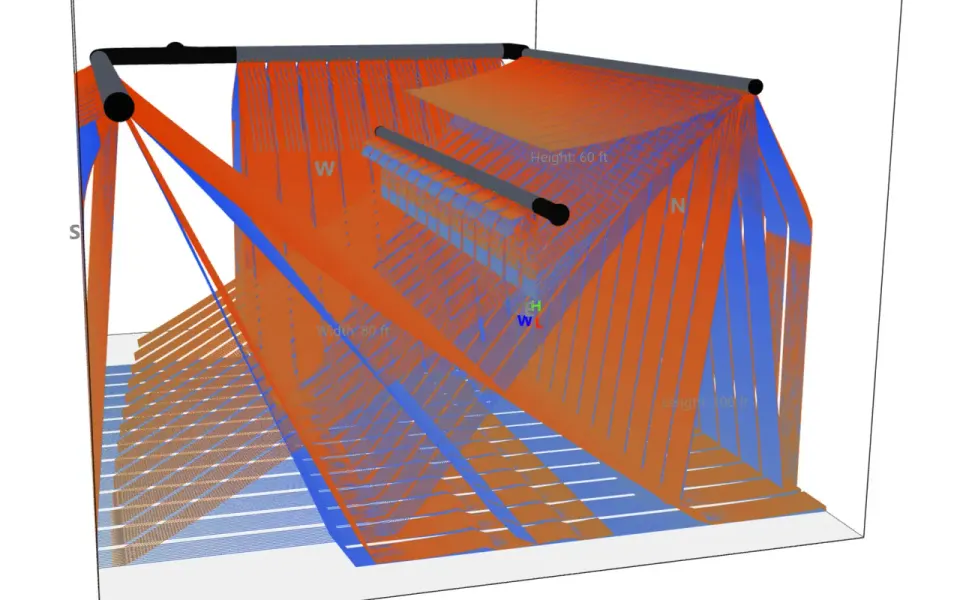
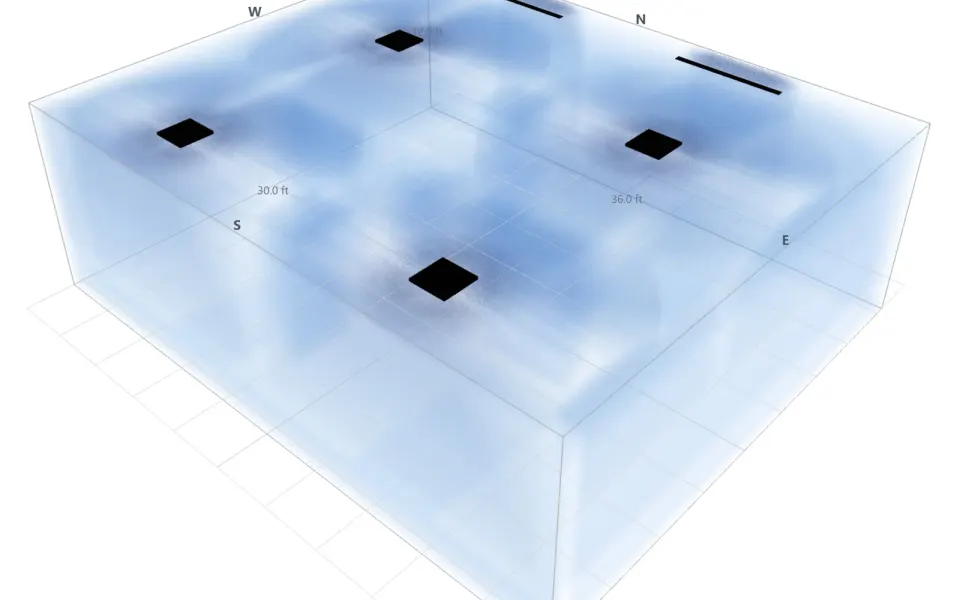
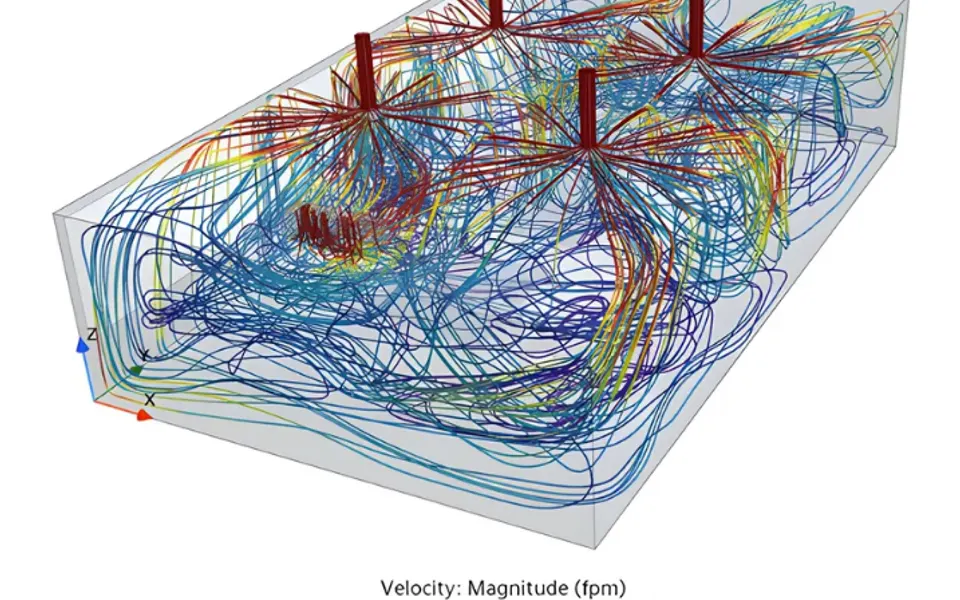
- Read SelectiV’s velocity views to compare how the same jet behaves in cooling and in heating, and recognise room-level interactions: ceiling attachment, jets meeting, window wash, floor jet and the occupied zone.
- Place SelectiV on the catalogue · SelectiV · CFD spectrum, describe what Auto-Design evaluates across operating conditions, and decide when a project calls for Verified CFD instead.
- 11 7 min
Verified: what a CFD study of the room measures
- Describe the six results a Verified CFD report maps everywhere in the room (air velocity, temperature, mean age of air, PMV/PPD, CO2, Ez factor) and what each one reveals.
- Outline how a study runs: the room recreated in 3D, the operating conditions (each one a full simulation), the simulation following the ASHRAE 62.1-2022 method, and the report.
- Explain the energy efficiency analysis: a design compared with a normalized design per ASHRAE 105-2021, and the two metrics that turn air mixing into energy (airflow or supply temperature for comfort, Ez and outdoor air for air quality).
- 12 8 min
Room First: design from the occupants up
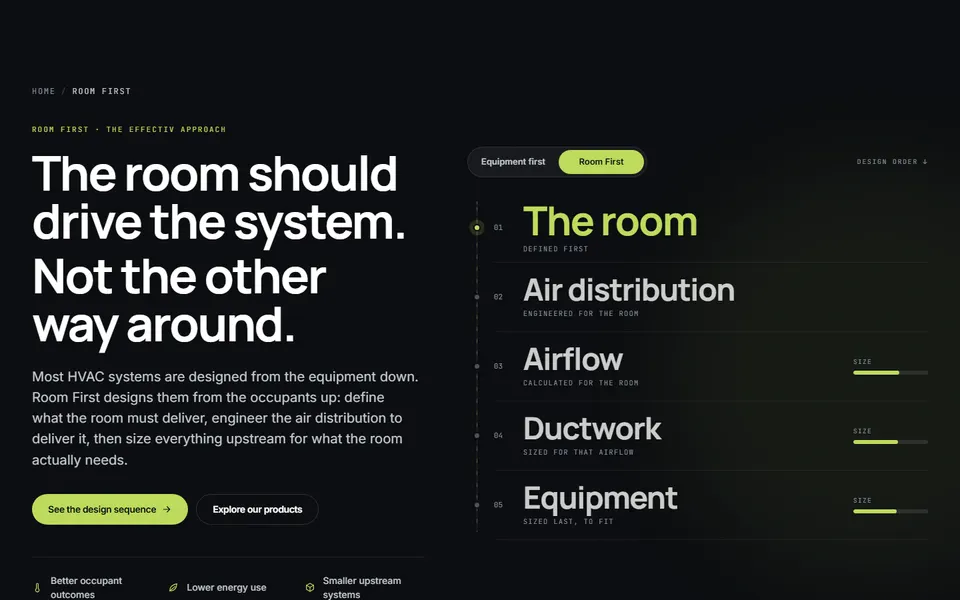
- Contrast equipment-first and Room First design order across the five stages (occupant outcomes, air distribution performance, required airflow, ductwork, equipment) and state what each stage decides.
- Explain how mixing becomes a design number through Ez (Voz = Vbz / Ez, ASHRAE 62.1 table defaults, Appendix C demonstration by CFD) and why poor mixing is paid for twice.
- Place the tools of this course in the Room First sequence: define the room’s needs, predict the airflow with SelectiV and, when proof is needed, Verified CFD, tune the diffusers, then size the ductwork and the equipment last.

Certificate of completion. You self-report the hours to your licensing body; the course is not accredited by a third party.